American appliances in English cabinetry.
Your appliances are larger than ours, they are bought in America, and they decide the elevation. Which is why we ask what you are buying before we draw rather than after.
Nothing derails an imported kitchen faster than an appliance decision made after the drawings. It is the most common cause of a change that costs real money, and it is entirely avoidable.
The sizes are not the same
English kitchens are built around narrower appliances than American ones. A range in an English house is commonly 900mm or 1000mm wide; in an American house it is very often 36 or 48 inches, and a 48-inch range with a matching hood is a different piece of architecture altogether. Refrigeration is the bigger difference again: a full-height column pair, or a 48-inch built-in, takes a run of wall that an English kitchen would have given to two tall cupboards and a broom store.
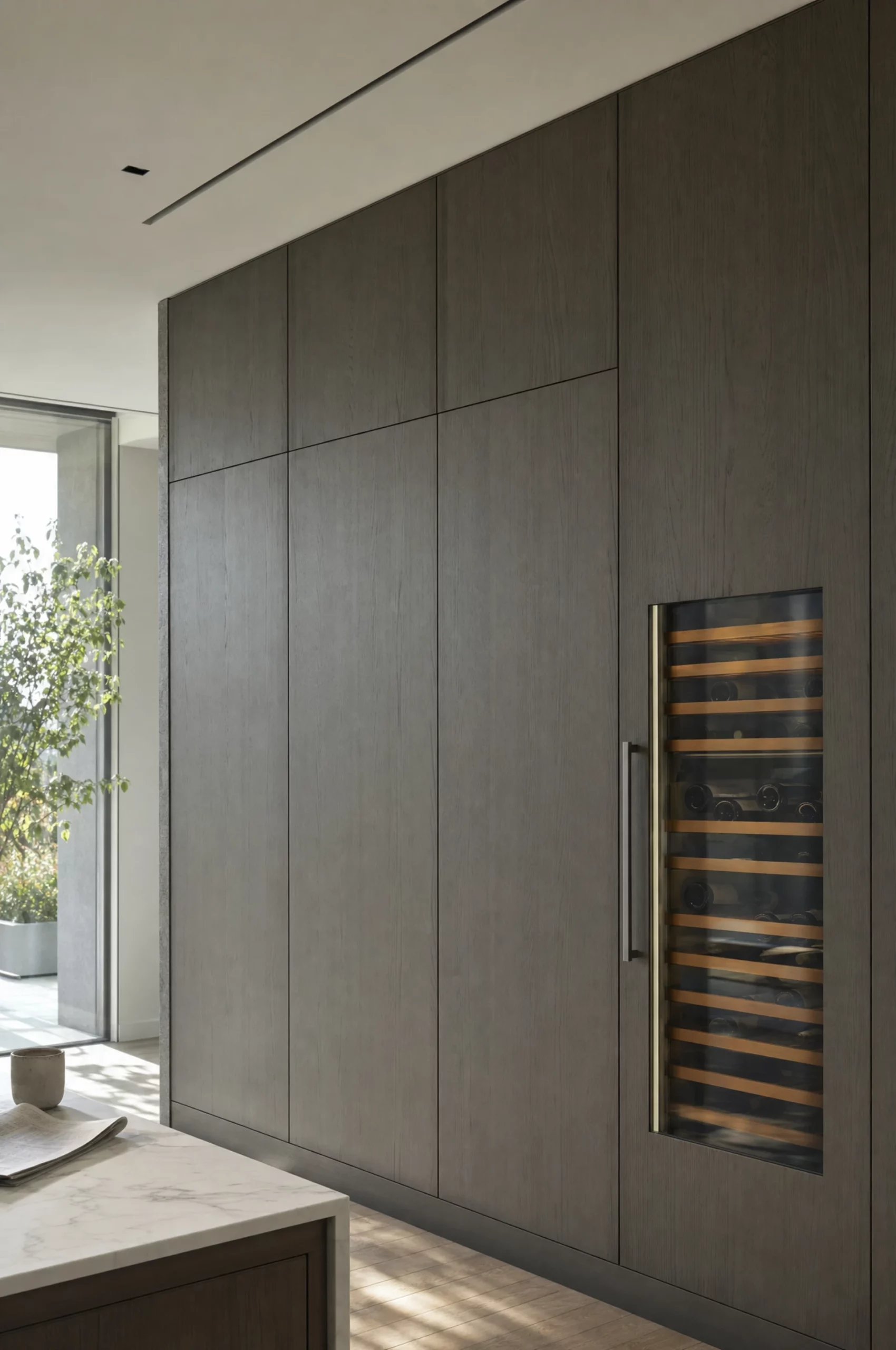
None of that is a problem. It is simply a different elevation, and it has to be the elevation we draw from the beginning rather than one we adjust to at the end.
What we need, and when
Model numbers, before the drawings are signed off. Not a category and not a brand — the actual model, because the specification sheet gives us the carcass dimensions, the door swing, the hinge side, the service clearances and the ventilation requirement, and those are what the joinery is set out around.
For in-frame work this is not a formality. The frame is laid out around the appliance carcass and its clearances before anything is machined, and the doors either side have to line through with the appliance doors rather than with each other. Change the appliance afterwards and you are not moving a cabinet, you are re-making a frame.
Integration
Anything that can be taken behind a matching front usually should be. A dishwasher, a refrigerator, a wine cabinet or a freezer standing in a gap between two cupboards is the thing that makes an expensive kitchen look like a fitted kitchen. Framed into full-height joinery, it disappears into the room.
Not everything wants to disappear. A range is the center of a farmhouse kitchen and should look like one — which is why the Farmhouse and the Norfolk put a painted mantel over it rather than a hood, and why the Essex builds a carved chimneypiece around it. The rule we use: if it is a piece of equipment, hide it; if it is the reason the room is arranged the way it is, frame it.
What we do not do
We do not supply your appliances and we do not connect them. You buy them in America, from an American dealer, with an American warranty and an American service engineer — which is exactly what you want when something fails in year four. Your own licensed electrician and plumber make the connections.
What we supply is the cabinetry, the countertops and the joinery around all of it, drawn to the appliances you have chosen and set out to the clearances the manufacturer requires. Where a piece of joinery has lighting in it, that is specified to work in your house and left for your electrician to connect.
Countertops, and the things around them
American countertop conventions differ from English ones in small ways that matter at the drawing stage: overhang, backsplash height, counter height itself, and where outlets are expected to sit. We work to your dimensions from the survey onward rather than converting ours at the end, which is a different exercise and produces a different set of numbers.
Sinks are worth an early conversation too. A fireclay farmhouse sink is a structural decision rather than a fitting: the cabinet beneath it is built to carry it and the countertop is cut around it, so it cannot be swapped late for a different one.
The short version
Choose the appliances early, tell us the model numbers, and everything else follows. Leave them until the drawings are done and you will either be paying for a second set of drawings or living with a compromise you can see every morning.
The stages, and where the appliance schedule sits →
The questions we get asked from America →
Tell us about the room.
Where the house is, roughly when you would like to be cooking in it, and what you have in mind. We will tell you honestly whether we are the right people for it.
Make an inquiry