Aftercare.
A ten-year guarantee, an adjustment once the house has been through a heating season, and a record of your kitchen kept for as long as we exist.
What the guarantee covers
Ten years on our cabinetmaking, joinery and installation. If a joint opens, a frame racks or a carcass fails, we put it right.
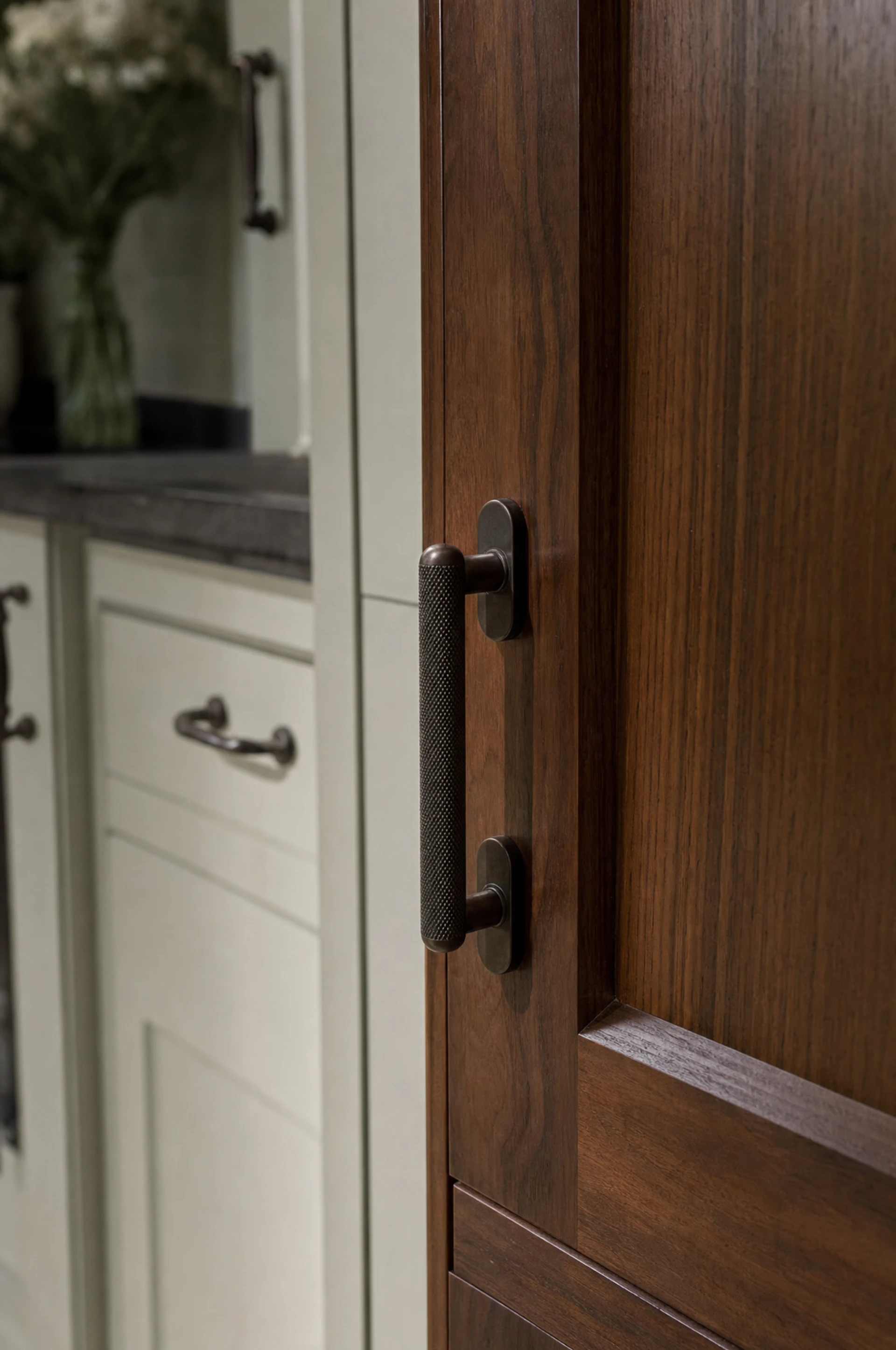
Hardware carries its own maker’s guarantee. We will tell you what that is for the hardware specified on your job, give you the paperwork, and help you make a claim under it rather than sending you to a website.
Finishing is covered for the same ten years against defect — a finish that lifts, crazes or fails to adhere is ours to put right. It is not covered against wear, and no honest finisher would tell you otherwise. A painted door beside a range will show its life within a decade. That is what repainting is for, and it is maintenance rather than a claim.
The adjustment visit
Timber moves in the first year, and an American house with forced-air heat moves it more than an English one does. Every kitchen gets an adjustment once the house has been through a heating season: every hinge and every runner set, doors lined through, anything that has tightened eased, plinths re-levelled where floors have settled, and timber countertops re-oiled.
How that visit is made for a house three thousand miles from the bench — whether by us, or by a fitter we have trained and worked with near you — is set out on the face of your quotation before you sign it. We would rather write it down than leave you to assume it.
Looking after painted work
Warm water, a little dish soap, a soft cloth, dried straight after. That is all.
No solvent, no cream cleaner, no scouring pad, no wipes containing bleach or alcohol. Any of them will burnish a hand-brushed finish and leave a shiny patch you cannot get out.
We leave you a labeled can of your paint, mixed from the same batch, and the code. Chips on an edge can be touched in with an artist’s brush.
Looking after timber and stone
Hard-wax oiled countertops want re-oiling roughly every six months in the first two years, then once a year. Clean with a damp cloth, wipe standing water, and keep the sink surround dry. A ring or a scorch sands out; we will show you how.
Lacquered and French-polished surfaces take no water and no alcohol. Coasters and a dry cloth.
Quartz and sintered stone need nothing but soap and water. Marble, limestone and slate are porous and want sealing on fitting and again every year or two. Marble will etch where lemon and wine sit on it. That is the material behaving as marble does, and we say so before you choose it.
Repainting
A hand-painted kitchen in a busy house looks tired at about fifteen years, and a quiet one at twenty. It does not need replacing. It needs repainting.
Doors and drawer fronts are stripped, filled, prepared and refinished, the frames are brushed in place, and everything is refitted. Your kitchen stays usable throughout apart from the doors.
Same color or a different one. It costs a fraction of a new kitchen, and it is the reason we build carcasses from birch plywood rather than particleboard: the boxes outlive the color.
Parts for life
We keep your cutting list, drawings, paint code, timber source and hardware schedule for as long as the company exists.
So we can make you a single replacement door in ten years, in the same timber, to the same profile, in the same color. We can add a cabinet to a run and have it match. If a hinge pattern is discontinued we hold the drawing and can machine around the replacement.
Moving house
People do take them. We have removed kitchens, stored them, remade what did not fit the new room and refitted the rest.
It is not free and it is not always sensible: if the new room is a different shape you may be paying to rework more than you keep. We will look at both, tell you honestly what carries over and what does not, and price the two options side by side. Sometimes the answer is that you should leave it and start again. We have said that before.
The whole commission → Painted kitchens and American weather → Write to the workshop →
Tell us about the room.
Where the house is, roughly when you would like to be cooking in it, and what you have in mind. We will tell you honestly whether we are the right people for it.
Make an inquiry