The four things that delay an English kitchen coming to America.
None of them are the making. Twenty to twenty-six weeks is a real number and we hold it. What moves is everything either side of the workshop.
Twenty to twenty-six weeks from sign-off to cooking in it, and three to seven days on site. That is the number, and it is not padded. When a commission runs late, it is almost never because the bench ran late.
One. Sign-off that is not really sign-off
The most expensive week in the whole program is the one where a drawing is approved by somebody who has not yet shown it to everybody with a view.
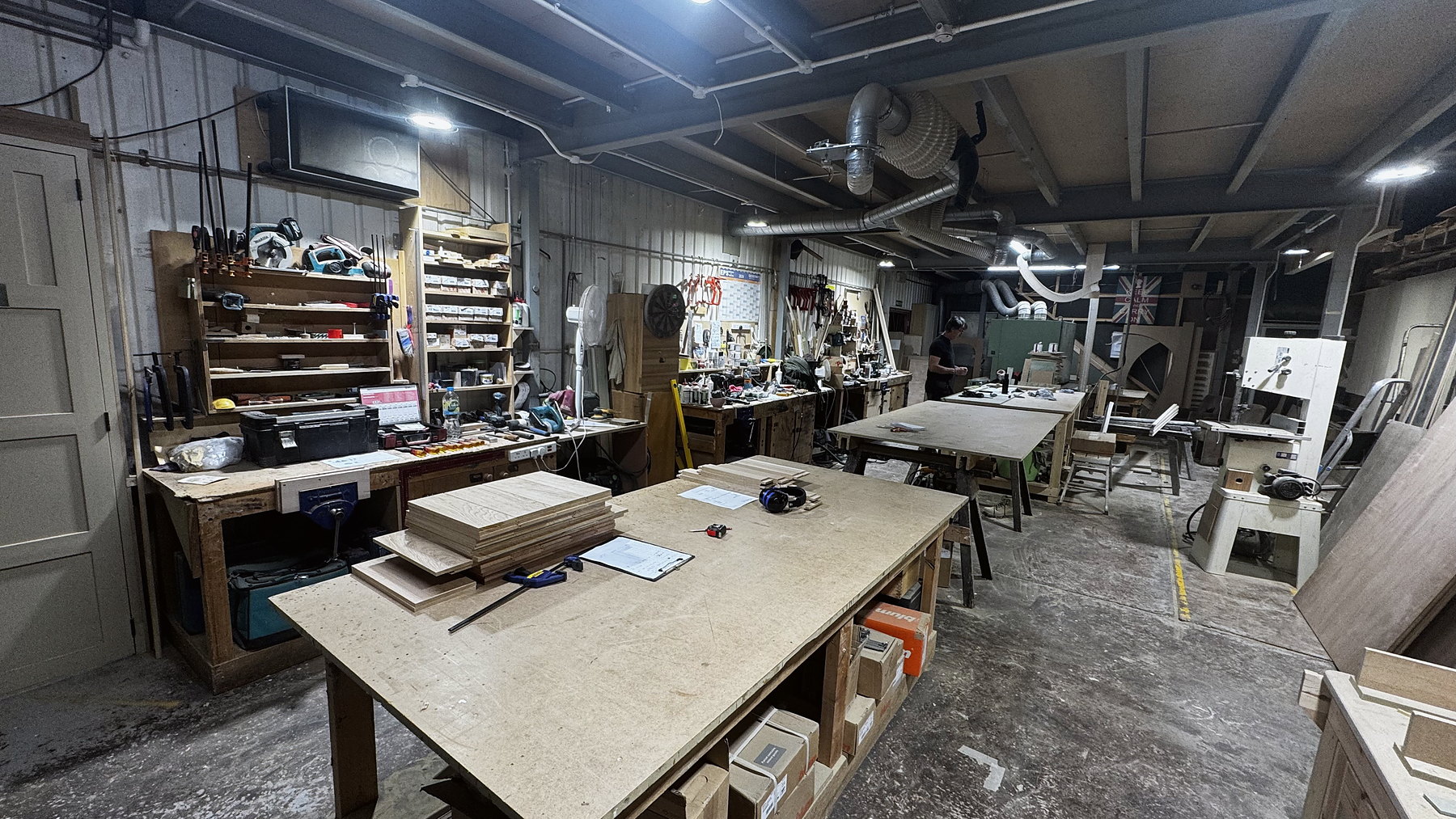
Once drawings are signed off, timber is selected, machined and jointed. A change to a run at week four is a conversation. The same change at week sixteen is a new frame, a new door, a new paint cycle and a place further back in the queue — and if the container is booked, it is a missed sailing.
What helps: get the client, the architect, the interior designer and whoever is actually going to cook in the room in front of the same drawing at the same time, once, before anybody signs anything.
Two. Appliances chosen late
In-frame joinery is set out around the appliance carcass and its service clearances before anything is machined. A 36-inch range and a 48-inch range are not a substitution; they are a different elevation.
We ask for model numbers rather than brands or categories, and we ask for them before the drawings are signed rather than after. It is the single most common cause of a second set of drawings.
Three. A site that is not ready
A kitchen cannot be installed into a room that is still being built. The joinery needs the room finished, dry and warm, the floor down, and the walls decorated to the point where cabinetry is the next trade through the door. Painted in-frame work in particular does not want to stand in a room that is still drying out.
Construction slips; everybody knows that. What turns a slip into a problem is not telling us. We are booking a container, a crossing and a team of cabinetmakers onto an airplane, and all three are far easier to move six weeks out than six days out.
Four. The port
The crossing cannot be compressed, and it is the part of the program we control least. What we can do — and do — is not share it.
Your kitchen travels in its own sealed container rather than as part of a consolidated load. Shared freight is cheaper and we do not use it: it means somebody else’s cargo decides your sailing date and your clearance, and it means the doors are opened between Suffolk and your house. A dedicated container costs more and removes three of the four things that go wrong.
Customs itself is routine. British-made cabinetry enters the United States at a capped rate of duty, the paperwork is the same paperwork every time, and the duty is inside the price you were quoted rather than arriving as a bill at the port. What is not predictable is how long a given port takes in a given week, which is why the number we quote is a range and not a date.
What we do about all of it
We survey in blocks and book the crossing early. We ask for the awkward information at the start, when it is still cheap. And when something on your side moves, we would far rather hear it the day it moves than the week it matters.
The honest summary is that the making is the predictable part. Everything either side of it is a matter of talking early.
Tell us about the room.
Where the house is, roughly when you would like to be cooking in it, and what you have in mind. We will tell you honestly whether we are the right people for it.
Make an inquiry