A painted kitchen in a climate that is not England’s.
Timber moves with the moisture in the air, and American air does more of it than English air. What that means for hand-painted in-frame work, and what we do about it at the bench.
Suffolk has a mild, damp, fairly stable climate. Timber in a Suffolk house sits at a moisture content that does not change dramatically between January and August. Large parts of the United States do not work like that, and any English maker who does not say so out loud has not thought about it.
What actually happens
Timber takes up moisture from the air and gives it back again. As it does, it moves — almost entirely across the grain, very little along it. A solid panel grows wider in a humid summer and narrower in a dry, heated winter. This is not a defect and it does not stop; it is what wood does, and it is why furniture has been built with floating panels for four hundred years.
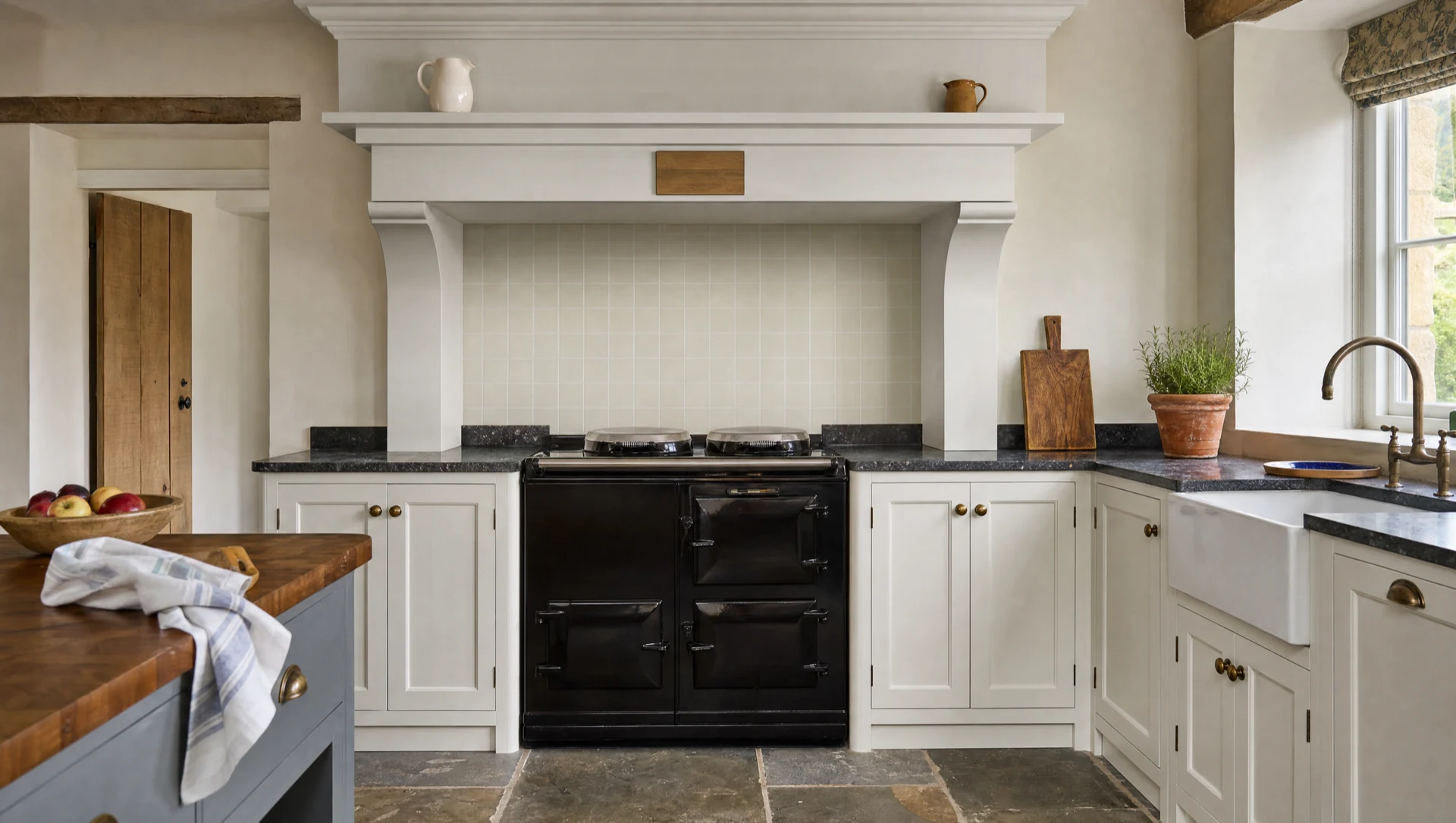
The difference between Suffolk and a heated house in New England in February is the size of the swing. Central heating in a cold, dry winter pulls indoor humidity a long way down; an unconditioned August somewhere humid pushes it a long way up. The same door sees a bigger annual range, so it moves more.
Where it shows, and where it does not
On a frame-and-panel door — which is what every in-frame door is — the panel floats in a groove in the frame and is not glued in. It is free to move without pushing the frame apart. What you may see over a first winter is a hairline of unpainted timber appearing at the edge of a panel, where the panel has shrunk back out of the paint line. It is normal, it is not a failure, and it closes up again in summer. A maker who paints a panel rigidly into its frame is storing up a split.
Where movement genuinely matters is the fit of an inset door in its frame. The gap around an in-frame door is the thing your eye reads, and a door that has swollen a fraction in August fits differently from the one that was hung in March. So the gaps are set out with that in mind, rather than to the tightest tolerance we could physically achieve.
What we do at the bench
Timber is selected and conditioned before it is machined, not after. Frames are mortise and tenon rather than glued butt joints, so the joint has mechanical strength and does not depend on adhesive alone. Panels float. Carcasses are 18mm birch-faced plywood (a shade under 3/4 inch), which is far more dimensionally stable than solid timber and does not much care what the weather is doing, so the box stays square even when a door does not.
Paint goes on in four coats, brushed by hand, and the final coat is cut in on site after the kitchen is installed. That last coat matters more than it sounds: it is applied in the house, at the house’s own temperature and humidity, over joints that have already closed up in position.
What we ask of the house
Not much, and nothing unreasonable. Let the room be finished, dry and warm before the joinery arrives — new plaster and fresh screed put an enormous amount of water into the air, and a painted kitchen installed into that will move twice: once as the building dries and again as it settles. And if the house is going to be closed up and unheated for months at a time, tell us, because that is a different specification conversation.
And if something does move
Ten years on our own work, and the same nine people who made it. A door that needs re-hanging is a small job: the hinge is in a solid frame, and the frame is solid for exactly this reason. Small adjustments we can talk you through or send parts for. Anything that needs a bench, we come.
Why the trade stayed where it started →
The questions we get asked from America →
Tell us about the room.
Where the house is, roughly when you would like to be cooking in it, and what you have in mind. We will tell you honestly whether we are the right people for it.
Make an inquiry