Countertops for an English kitchen.
The countertop is the second-largest decision in the kitchen and the one most often made from a sample the size of a postcard.
How to choose, in one paragraph
Decide what you are willing to look after, then choose. Every countertop material is a trade between how it looks on day one and how it looks on day one thousand, and almost every regret we hear about is somebody who chose for day one. There is no maintenance-free surface that also looks like marble, and anybody who tells you otherwise is selling one.
Marble
Nothing else looks like it and nothing else ages like it. Marble is calcium carbonate, so acid etches it — lemon, wine, vinegar, tomato, some cleaners — and the etch is a dulled patch, not a stain, so it cannot be wiped off. Honed marble hides it far better than polished.
It is the right choice for somebody who wants a surface with a history on it, and the wrong choice for anybody who will be upset the first time it happens. Sealing slows staining; it does not stop etching. Carrara, Calacatta and Statuario are the ones most asked for.
Granite and the harder stones
Granite is dense, hard, heat-tolerant and does not etch. It is the traditional answer in a working kitchen and it is still a good one. Belgian Black, and the dark speckled granites, sit particularly well against hand-painted in-frame cabinetry.
Soapstone deserves a mention here because it is a genuinely American answer and a good one: soft, dark, unetchable, and it takes an oiled patina that suits an in-frame painted kitchen very well. Slate is softer than it looks and marks, but it takes a beautiful honed finish. Limestone is softer again and porous; it belongs on a run that does not take heavy wear, or in a pantry.
Engineered quartz
A resin-bound stone composite. Non-porous, consistent, no sealing, and it does not etch — which is why so many kitchens end up with it.
Its weakness is the resin. Above roughly 300 degrees the resin scorches, so a pan straight off the cooktop will leave a mark that cannot be polished out. Pigment behavior under strong ultraviolet varies by product, so if a pure white is going in front of a south-facing slider, ask the fabricator for the manufacturer’s own guidance before you commit.
Worth knowing: cutting engineered quartz produces respirable crystalline silica, which is a serious occupational hazard and one that several jurisdictions have moved to regulate. Ask who is fabricating yours and how they control it. It is a fair question and a good fabricator will welcome it.
Sintered surfaces
Mineral powders fired at very high temperature into a dense sheet. Effectively unstainable, unaffected by heat, and available in very large formats with a slim edge.
Harder to make good than stone if it is damaged, because on many products the color is a surface layer rather than a body color, so a chip on an edge shows the substrate. Cut-outs need generous radii and careful handling. Ask the maker what their repair actually looks like before you specify it on an island with a corner people walk past.
Timber
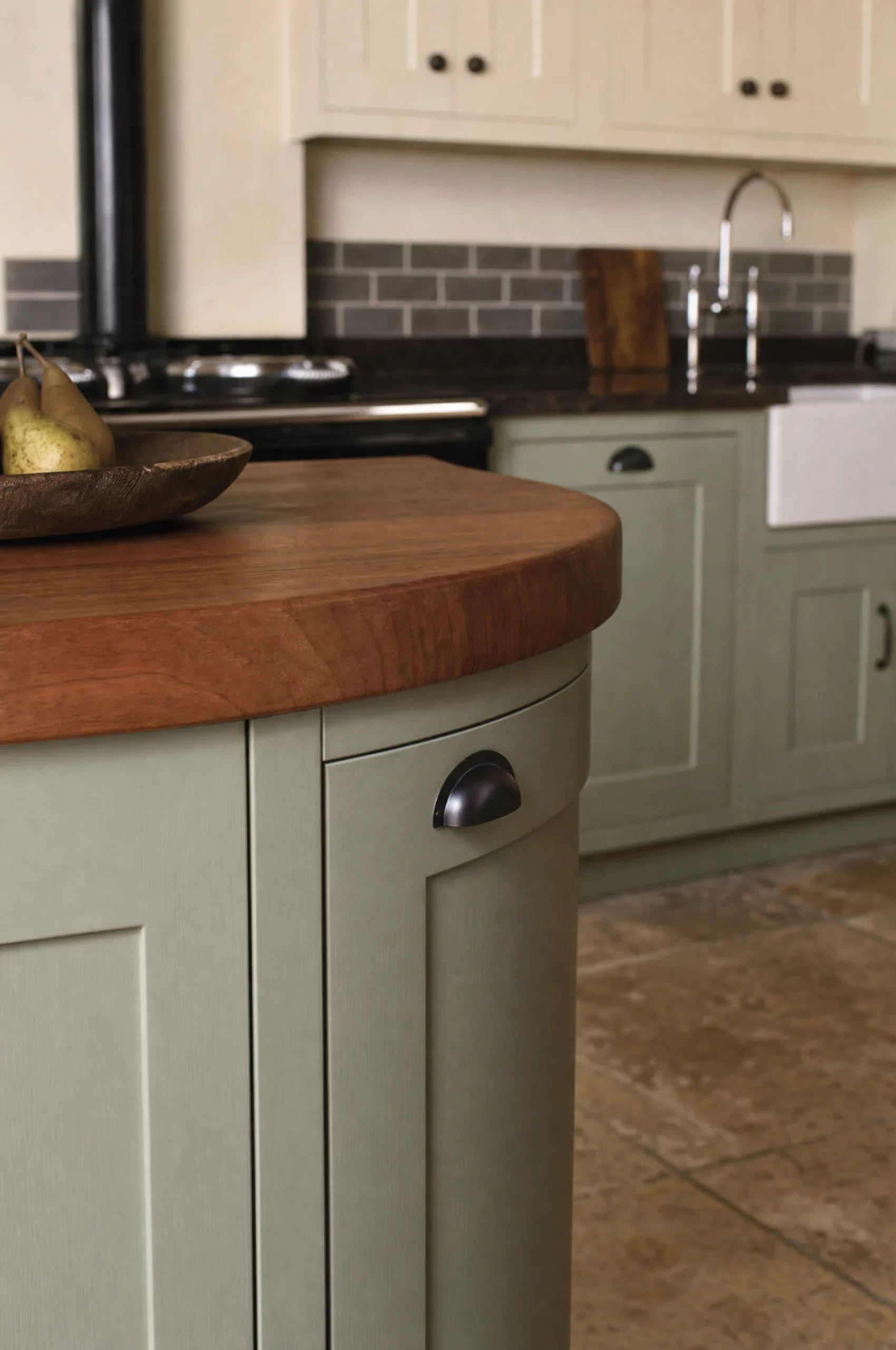
Warm, quiet, repairable, and the only countertop that gets better with damage. Oak, iroko, walnut, or end-grain block. Finished in oil rather than lacquer, so it can be sanded back and re-oiled rather than replaced.
It moves with humidity, so it is fixed with slotted fittings that let it. It will mark around a sink and it will darken. Both of those are the point. Timber tops are made here alongside the cabinets and travel in the same container, so there is no second trade and no second visit.
Mixing them
The best kitchens in this workshop usually have two. Stone where the work happens and timber where people sit is the commonest, and a thick timber breakfast bar set slightly lower than a stone perimeter is the arrangement we draw most often.
A second material also solves the practical problem: a marble pastry slab set into an oak island gives you the surface that is right for the job without committing the whole room to it.
How we handle it on an American job
Stone is templated after the cabinets are installed and levelled, never before, and it is cut by a fabricator near you rather than shipped across an ocean. We specify it, we detail the overhangs and the supports on our drawings, we are on site for the template, and we set the cabinet heights so the finished top lands where the drawing says.
We will tell you when the stone you have chosen is wrong for how you say you cook. It is a cheaper conversation now than in eighteen months.
Tell us about the room.
Where the house is, roughly when you would like to be cooking in it, and what you have in mind. We will tell you honestly whether we are the right people for it.
Make an inquiry