Shaker is not a style, and the kitchen named after it is not Shaker.
The most-used word in American kitchen showrooms belongs to a religious community that would have been appalled to find it selling anything. What the word once meant, what it means now, and why the distinction is worth keeping.
Walk into any kitchen showroom in America and you will be offered a Shaker kitchen. Walk into a second one and you will be offered a different Shaker kitchen. The word has been doing so much work for so long that it has stopped carrying any.
Who they actually were
The Shakers were a religious community — formally the United Society of Believers in Christ’s Second Appearing — who established themselves in America from the 1770s. Their founder, Ann Lee, was English, from Manchester, and emigrated with a small group of followers. They were celibate, communal, and they believed that work done well was a form of prayer.
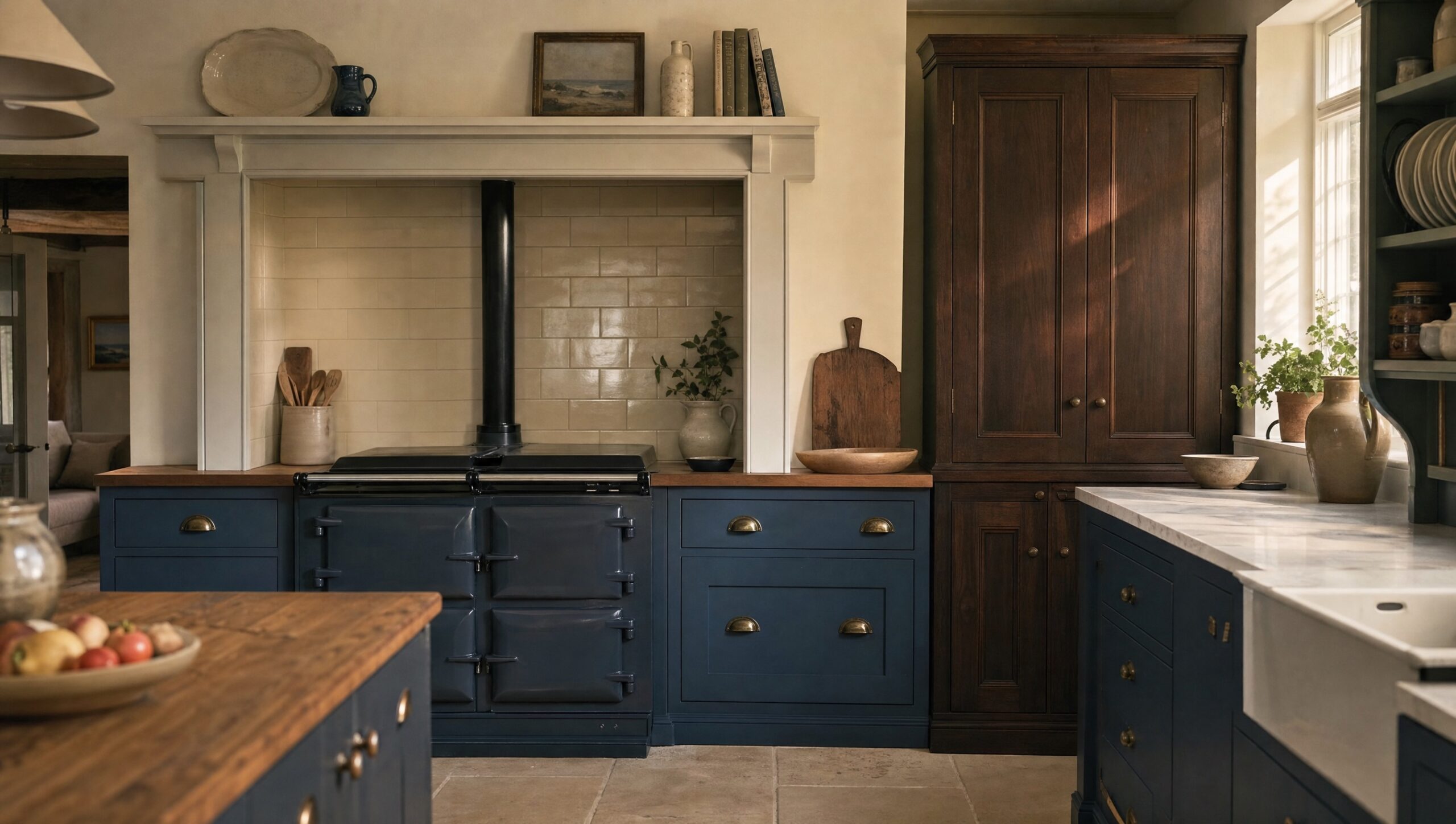
That belief is the whole explanation for what their furniture looks like. It is plain because ornament was vanity, not because plainness was fashionable. It is well made because bad work was a moral failure. The tapered leg, the peg rail, the absence of carving, the honest joint left visible — none of it was a design decision in the sense we mean the phrase. It was theology, expressed in maple.
What actually characterises it
Not the door. Shaker furniture is barely about doors at all. It is about proportion, the absence of applied decoration, joints that do their job without apology, and a refusal to make anything look like something it is not. A Shaker cupboard is built into the wall of a room and finished in a thin color wash. A Shaker chair is light enough to hang on a peg while the floor is swept, which is exactly why the peg rail exists.
There is a great deal in that worth borrowing. Very little of it is borrowed by the thing sold under the name.
What the showroom means by it
A five-piece door: two stiles, two rails and a flat panel recessed inside them, with no molding on the inside edge. That is it. That door is a perfectly good door — it is what our own Suffolk range uses — but it is a construction, not a style, and versions of it have been made in English joinery for a great deal longer than the Shakers existed.
What the showroom is really selling under the word is an idea: quiet, unfussy, unlikely to date. Which is fair enough as far as it goes. The trouble is that the word has become so elastic that it now covers a hand-made in-frame door in solid tulipwood and a thermofoil-wrapped MDF panel with a routed groove pretending to be one. Both are Shaker. Neither description tells you anything.
Why the distinction is worth keeping
Because it makes you ask better questions. If Shaker tells you nothing, you have to ask what the door is actually made of, whether the panel is solid timber or a sheet material, whether it floats or is glued in, whether the frame is mortise and tenon or dowelled, whether the door sits inside the frame or over it, and how the paint got there.
Those questions have answers that differ by thousands of dollars and by decades of life. The word does not.
What we would rather say
Our Suffolk range is a hand-painted in-frame kitchen with a flat recessed center panel, plain stiles and rails, no molding and no applied ornament. Solid timber frames, mortise and tenon, floating panels, four coats brushed by hand. If you want to call that Shaker, we will not argue — it is closer to the real thing than most of what carries the name.
But the reason it looks the way it does is not that a community in New Lebanon decided ornament was vanity. It is that a flat panel in a plain frame is the quietest thing you can put in a room, and some rooms want quiet.
The Suffolk, and the six other ranges →
In-frame, face-frame, frameless →
Read next
Tell us about the room.
Where the house is, roughly when you would like to be cooking in it, and what you have in mind. We will tell you honestly whether we are the right people for it.
Make an inquiry